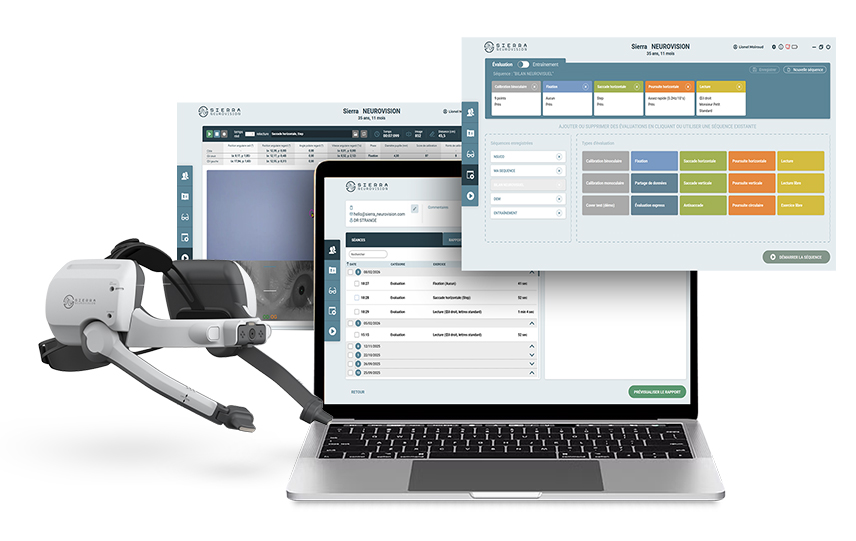
Eye tracking for Optometrists and Orthoptists

A single solution to analyze and train eye movements

Fixation, Saccades, Pursuits, Reading and Visual strategy

EyA Perfomer Solution

EyA helps analyze and train oculomotor function.

EyA makes it possible to analyze eye movements and implement visual training within the same environment. Fixation, saccades, smooth pursuit, and reading can be observed more precisely to better understand how gaze functions.

By combining measurement, visualization, and training, EyA helps make training more reliable by using the data collected during the exercises. The measurements recorded throughout the session help adjust progression, track changes over time, and maintain a more objective approach throughout the training process.

Concrete benefits for your practice

EyA helps objectify oculomotor function and make training more reliable.

through clear measurements directly linked to the exercises.

Access objective data on fixation, saccades, smooth pursuit, and reading to support your analysis.

The measurements collected during the exercises make it possible to fine-tune progression and maintain objective benchmarks throughout the training process.

Visualize the results, compare changes over time, and make reporting easier through a more structured reading of the data.

From measurement to results

An intuitive interface for precise analysis

Session creation

PARAMETERIZED MEASUREMENTS AND TRAINING FOR FIXATION, SACCADES, ANTISACCADES, SMOOTH PURSUIT, READING, TEXT, AND FREE IMAGE TASKS

Session creation allows you to build sequences tailored to analysis and training goals. EyA includes different types of measurements, such as fixation, saccades, antisaccades, smooth pursuit, reading, as well as text- and image-based tasks.

Training parameters can be adjusted to structure a consistent program across all eye movements, personalize sequences, and directly link the exercises to the measurements collected during training.

Saccades

Reflexive or programmed paradigms, with objective measurements directly linked to the exercise.

The saccade exercise makes it possible to analyze rapid gaze shifts between multiple visual targets. EyA distinguishes between reflexive and programmed saccade paradigms in order to explore different dimensions of oculomotor control depending on the instruction and the task involved.

The results make it possible to calculate several metrics useful for analysis, including latency, speed, gain, accuracy, and movement dispersion.

Pursuit

Adjustable speeds and directly usable measurements to track gaze fluidity.

The smooth pursuit exercise makes it possible to observe the eye’s ability to follow a moving target in a fluid and continuous way. The exercise parameters can be adjusted, including pursuit speed, in order to adapt the task to the observed level and the training goals.

EyA calculates useful indicators for analyzing pursuit quality, such as gain, tracking stability, movement accuracy, and any deviations from the expected trajectory.

Reading

FIXATIONS, SACCADES, AND REGRESSIVE SACCADES TO BETTER UNDERSTAND HOW GAZE IS ORGANIZED ON A WRITTEN TEXT

The reading exercise makes it possible to explore how gaze is organized on a written text. EyA helps observe the sequence of fixations, reading saccades, and the overall structure of visual exploration in order to better understand the strategies used during the task.

The results highlight several indicators useful for analysis, such as fixation duration, the organization of eye movements, and the calculation of regressive saccades. By combining visualization of eye movements with structured result reporting, EyA supports analysis, helps track changes over time, and enables more precise guidance of training.

Training

PROGRESSION METRICS AND CUSTOMIZABLE FIXATION, SACCADE, AND SMOOTH PURSUIT TRAINING, WITH IMMEDIATE VISUAL FEEDBACK.

EyA makes it possible to customize fixation, saccade, and smooth pursuit training with direct visual feedback, helping the patient better perceive the effect of their gaze on the task being performed. This approach makes it possible to work more specifically on oculomotor accuracy without introducing hand-eye coordination demands.

At the same time, the practitioner has access to objective metrics to track changes, adjust progression, and support training with measurable benchmarks over the course of sessions.

Discover EyA,
the new standard for visual performance